
Airport Infrastructure Revolution: Building for 2035 and Beyond
Mati Binte Zahir from TT Desk : Brussels — As global passenger volumes accelerate and shoulder seasons flatten, the aviation industry faces a defining question: can airports keep pace with demand while maintaining sustainability, efficiency, and service quality? This was the central theme of the “Airport Infrastructure Revolution” panel at the Global Tourism Forum Annual Meeting 2025 in Brussels.

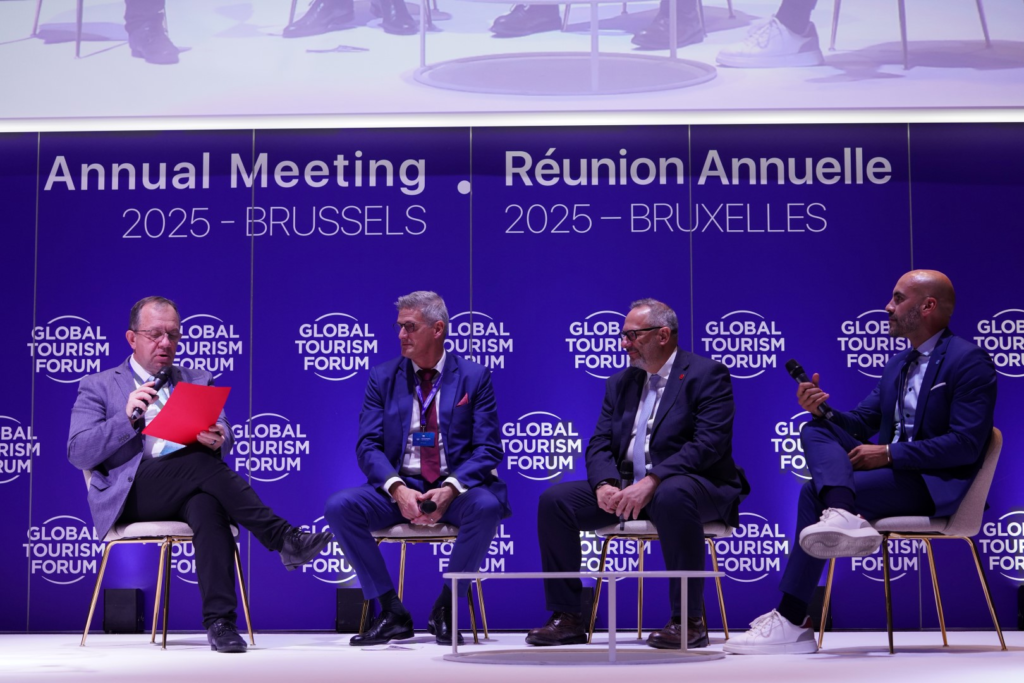
Brussels — As global passenger volumes accelerate and shoulder seasons flatten, the aviation industry faces a defining question: can airports keep pace with demand while maintaining sustainability, efficiency, and service quality? This was the central theme of the “Airport Infrastructure Revolution” panel at the Global Tourism Forum Annual Meeting 2025 in Brussels.
Moderated by Curtis Grad, Partner at Modalis Infrastructure, the discussion brought together industry leaders:
Giovanni Russo, COO — Geneva Airport & Airport Council International (ACI) Representative
Fernando Parretta, Madrid Airport Manager — ITA Airways
Piervittorio Farabbi, COO — Tirana International Airport
Together, they emphasized the urgent need for airports to transform their physical and digital infrastructures to support rapid tourism recovery and long-term growth.
Tirana: A Case Study in Rapid Capacity Expansion
Tirana International Airport has experienced one of Europe’s fastest aviation recoveries. According to Farabbi:
2019: 3.3 million passengers
2024: 10.7 million passengers
Connectivity growth: +56% in five years — highest in Europe
He credits a strategic €100 million CapEx program to stretch the airport’s original 4-million passenger design while simultaneously developing Albania’s tourism economy.
“We poured concrete while the aircraft were waiting to park,” he remarked, noting the balance between speed and operational integrity.
Airlines + Airports: One System, One Customer
From the airline perspective, Parretta stressed that operational success relies on collaborative efficiency:
“Airlines and airport operators must work together as one system. The passenger is our shared customer.”
With travel anxiety still high, he warned that technology is a tool — not a substitute for empathy. The industry’s biggest challenge, he said, is converting real-time data into real-time decisions without losing the human element.
Europe’s Hidden Bottleneck: Airspace
Russo highlighted a critical but often overlooked constraint: Europe’s congested skies.
Terminal expansion is stalling in Central Europe
Runway additions remain politically difficult
Airspace efficiency must drive capacity growth
He called for enhanced coordination through initiatives like “Think Network,” harmonizing airlines, airports, ground handlers, and air navigation providers:
“A ten-second improvement in air separation can translate into ten-minute gains by nightfall.”
Sustainability: Luxury or Necessity?
The panel agreed sustainability mandates are advancing faster in Europe than in developing regions. Parretta stressed small actions in emerging markets can still drive meaningful impact:
“One day without plastic is better than doing nothing. Sustainability is measured in how we invest our resources — not only in size.”
Infrastructure modernization — including electric ground equipment, renewable energy, and waste reduction — will increasingly shape route viability and tourism perception.
Workforce Challenges: Making Aviation “Exciting Again”
Airports face a severe HR recruitment and retention dilemma post-pandemic:
Younger employees demand flexibility
Competition with hospitality and other sectors is fierce
Passion for the industry has weakened
Russo noted:
“Try loading bags onto a plane from home — it’s impossible. We must restore the pride and appeal of aviation careers.”
Farabbi added that Tirana’s average workforce age is just 28, offering an opportunity to develop new talent if proper incentives exist.
Digital Passenger Journey: Still a Long Runway Ahead
While technology promises frictionless travel, Parretta cautioned that society must move at the same pace:
“Even connecting to airport Wi-Fi is still difficult for many travelers.”
The panelists foresee multimodal hubs—where rail, road, and air integrate seamlessly—as essential to future mobility. Customized passenger-centric models will differentiate service levels:
Low-cost travelers demanding speed and simplicity
Premium travelers seeking hospitality-driven experiences
Farabbi shared a compelling example: passengers booking a €50 low-cost ticket but paying €150 for VIP terminal services — a strong case for experiential value.
Toward 2035: A Seamless, Connected Future
The panel closed with a bold prediction:
A single ticket for door-to-door travel — including eVTOL transfers — will become mainstream within the next decade.
Convenience will be the new premium.