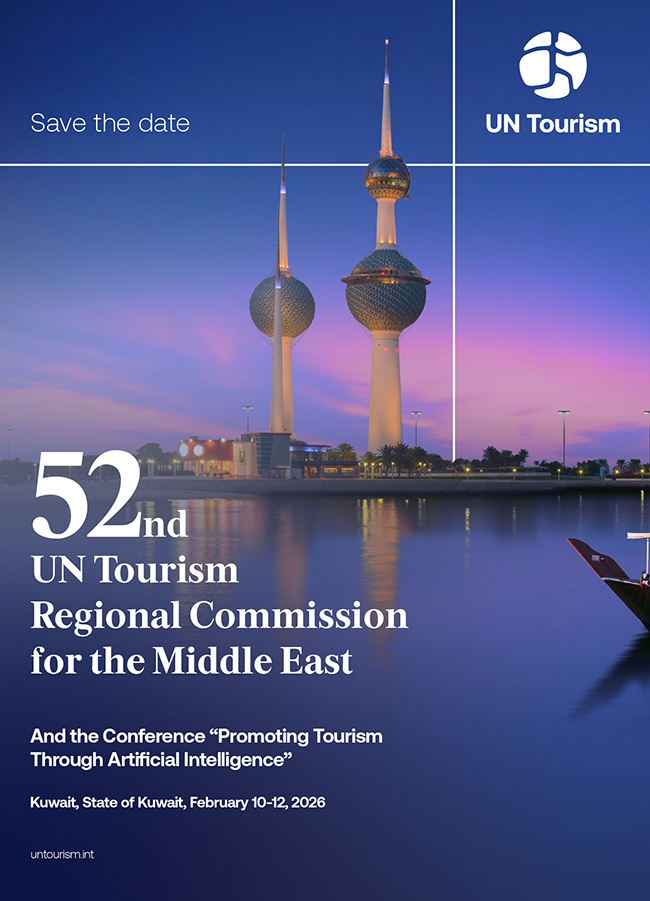
The 52nd UN Tourism Regional Commission for the Middle East and the Conference “Promoting Tourism Through Artificial Intelligence”
Dalton Zahir from TT Desk:
Workshop: Unlocking AI for Tourism
Key Considerations
Organizers: UN Tourism & Amadeus
Methodology: Design Thinking
Workshop Format:
- Session 1: Hybrid – In person (those attending the side event in Kuwait) and via
streaming for those attending online from their countries – 1 hour - Session 2: Three online follow up sessions (one per AI maturity level group of
countries) – 2.5 hours (one month later)
Target audience: Officials from Member States
Implementation: Global scale. To be organised at every Regional Commission (pilot at the
Regional Commission for the Middle East)
- Background and Rationale
This workshop is framed within the principles of the Riyadh Declaration on the Future of
Tourism, adopted by the General Assembly last November 2025, as a shared roadmap for
transforming the tourism sector through innovation, sustainability, and inclusive growth.
The Declaration recognizes technology — including artificial intelligence — as a key enabler
of a more resilient, human-centered, and sustainable tourism ecosystem, while emphasizing
that innovation must be guided by ethical standards, transparency, and public value.
The Implementing Artificial Intelligence in Tourism – Guidelines and Recommendations
for the Public Sector (2025) publication has outlined different levels of maturity, best case
studies, and actionable recommendations and guidelines for Member States.
Artificial intelligence is rapidly transforming the tourism value chain. Effective adoption
requires specific capabilities. In this context, UN Tourism and Amadeus propose a practical
workshop based on design thinking, aimed at exploring how AI solutions can be integrated in
a responsible, innovative manner aligned with the real needs of the tourism sector, based on
the UN Tourism publication. - Overall Objective
To provide a co-creation space where participants understand and apply the design thinking
approach to identify concrete opportunities for integrating Artificial Intelligence in tourism,
based on the results of the UN Tourism publication on Implementing Artificial Intelligence in
Tourism – Guidelines and Recommendations for the Public Sector (2025). - Specific Objectives
- Introduce key design thinking principles applied to AI-driven innovation.
- Identify real challenges and opportunities in the tourism sector where AI can add
value. - Foster collaboration between public and private stakeholders around innovative
solutions. - Develop initial ideas for AI use cases with a user-centered approach.
- Methodology
The workshop is based on the design thinking methodology, combining inspiration, ideation,
and practical reflection, with a strong focus on the real-world applicability of AI in tourism.
The Implementing Artificial Intelligence in Tourism – Guidelines and Recommendations
for the Public Sector (2025) publication will serve as a knowledge basis for the same. - Workshop Structure
Session 1 – In-person or online – (1 hour)
- Welcome and context setting (UN Tourism & Amadeus) (5m)
- AI in tourism: trends and use case examples based on UN Tourism publication (15m)
- Design Thinking: The traveller journey (10m)
- Group work: identification of key area to focus on for the online session (15m)
- Explanation of preparatory work for the online session & Wrap up (10m)
Session 2 – Online Workshops (2.5 hours, one month later)
Structure: Three online workshops based on levels of AI maturity of the Member State.
Participants will be divided into groups based on the Implementing Artificial Intelligence in
Tourism – Guidelines and Recommendations for the Public Sector (2025): - Exploring: From little to no AI currently in use. The focus is on building foundations and
awareness. - Implementing: Some experience with AI (pilot projects or moderate adoption). The
focus is on scaling up and formalizing what works. Consolidating - Advanced: AI adoption across many aspects of tourism. The. T focus is on innovation,
refinement and sharing knowledge.
Outline: - Icebreaker and introductions (15m)
- Recap on the Area and Explore the User Persona/Segment (Empathize & Define)
(15m)
Brief recap of the selected area to focus on and user personas identified during the in
person session, aligning on the problem statements to be addressed. - AI Guided ideation (Ideate) (30m)
Collaborative group work to identify AI-based solution concepts, using structured
prompts to encourage creativity, feasibility, and user-centric thinking. - AI Action Plan (Prototype – light) (30m)
Initial development of use cases, defining: - the user and context,
- the problem addressed,
- the AI-enabled solution, and
- the value proposition and expected impact.
- Peer exchange and feedback (Test) (45m)
Group presentations followed by peer and facilitator feedback to refine and strengthen
the proposed concepts. - Wrap-up and next steps (15m)
Key takeaways, identification of promising ideas, and discussion of potential follow
up actions (pilots, further design, or collaboration opportunities).
- Expected Outcomes
- Identification of priority tourism challenges suitable for AI-based solutions.
- Action Plan for AI-driven solutions centered on user needs.
- Strengthened dialogue and collaboration among Member States participants and UN
Tourism for future projects, pilots, or joint innovation initiatives.
Practical information
Working documents
Item 2: Communication of the Chair (The State of Kuwait)
Item 3: Report of the UN Tourism Secretary-General
Item 4: Report of the Executive Director
Item 5: Report on the Activities of the Affiliate Members
Item 6: Member States interventions
Item 7: Venue of the 53rd RCME