
Rethinking Early Childhood in West and Central Africa: From Urgency to Systems Transformation
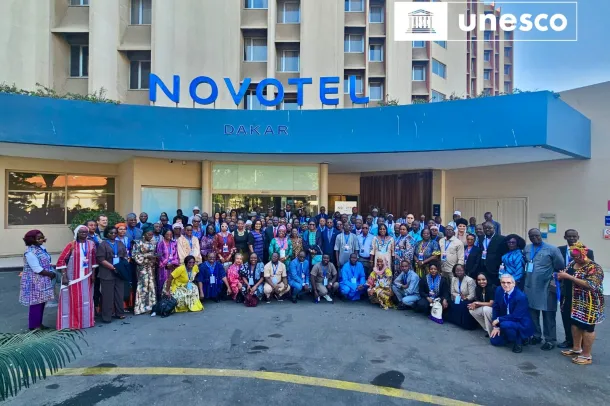
The Experts’ Meeting on Early Childhood Education and Development (ECED) in West and Central Africa was held in Dakar under the auspices of the Ministry of National Education of Senegal and co-organized by UNESCO, AfECN, WHO, and WAHO.

unesco
13 February 2026
In Africa, early childhood too often remains the invisible link in public policy. Its importance is widely acknowledged, yet too few systems are truly designed to meet the needs of young children. Inequalities take root in the earliest years of life, access to services remains uneven, data are fragmented, and investment still falls short of declared ambitions. In a region facing climate shocks, security challenges and socio-economic pressures, these early years are precisely what shape lifelong health, learning and resilience.
It is against this backdrop that the Experts’ Meeting on Early Childhood Education and Development (ECED) in West and Central Africa was held in Dakar from 20 to 22 January 2026, under the auspices of the Ministry of National Education of Senegal and co-organized by UNESCO, the African Early Childhood Network (AfECN) and the World Health Organization (WHO), in collaboration with the West African Health Organization (WAHO). The ambition was clear: to move from “why invest” to “how to transform”.
4/4
nextchevron_leftpreviouschevron_right
Throughout the discussions, UNESCO championed a structuring vision: ECED can no longer be treated as a marginal sub-sector, but must be recognized as a strategic pillar of human development. Drawing on the science of child development and a systemic approach to public policy, UNESCO highlighted the need to strengthen coherence across governance, financing, service quality, workforce, and data to deliver sustainable and equitable results at scale.
A strong emphasis was placed on policy steering and accountability tools, particularly the ECCE-PATT, presented as a key lever to help countries identify bottlenecks, prioritize reforms and translate diagnosis into operational decisions. Participants underlined the importance of sustained technical support to ensure effective national ownership of the tool and its integration into existing national policy and planning frameworks.
In a region increasingly exposed to multiple shocks, UNESCO also advocated making resilience a minimum standard for ECED systems by safeguarding the continuity of essential services such as health, nutrition, protection, and early learning, and by strengthening attention to the psychosocial well-being of children and families.
Beyond reflection, the meeting laid the foundations for a roadmap towards the 2026 Ministerial Conference, focused on action, prioritization, and shared accountability. By supporting this regional momentum, UNESCO reaffirms its role as a catalyst for evidence-based, equitable, and cooperative public policies—so that every child, from the very start of life, can benefit from the conditions needed to reach their full potential.
M.Z.I. Dalton Zahir | from TT Desk