Interview: Amplifying Women’s Voices in the Audiovisual Industry
On International Women’s Day, we turn our focus to a central question: how can festivals and the wider audiovisual industry do more to support women’s voices and leadership?
To explore these dynamics, we spoke with five professionals: Irene Giannakopoulos and Christiana Markou, Directors of the Amorgos International Tourism Film Festival; Mariana Calaça Baptista, Director of ART&TUR – International Tourism Film Festival; Spomenka Saraga, Director of the Zagreb Tourfilm Festival; and Laia Favà Dols, Project Manager of the Terres Travel Festival.
Across countries and contexts, a shared picture emerges: women are increasingly present and influential in audiovisual spaces, yet structural barriers persist. From funding gaps and limited leadership opportunities to the challenge of building networks that truly support women, these leaders share practical insights and lived experiences. Their perspectives highlight not only the progress achieved, but also the concrete actions still needed to ensure women’s voices are heard, valued, and sustained in the long term.
How would you describe the presence of women in the industry today?
Over the past years, in our Festival, and in other festivals that I have attended, I have witnessed a meaningful and encouraging increase in the presence of women across the audiovisual sector—as directors, producers, writers, programmers, and festival leaders. Today, women are more visible and more confident in claiming creative and decision-making roles.
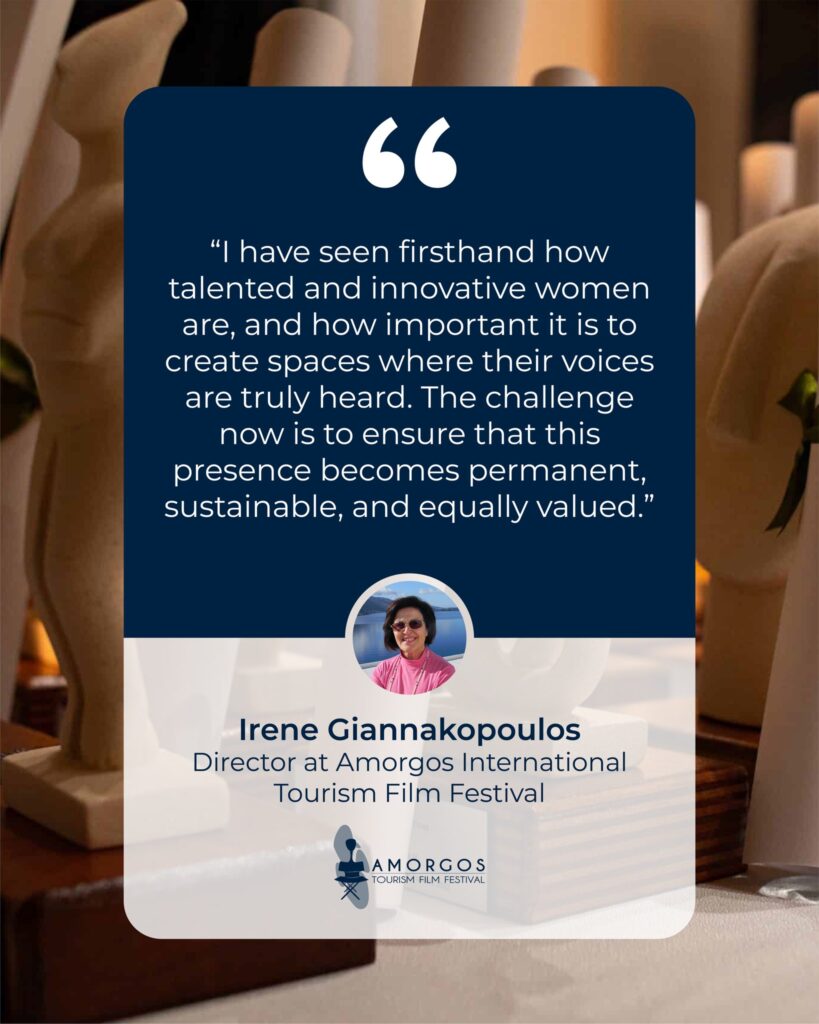
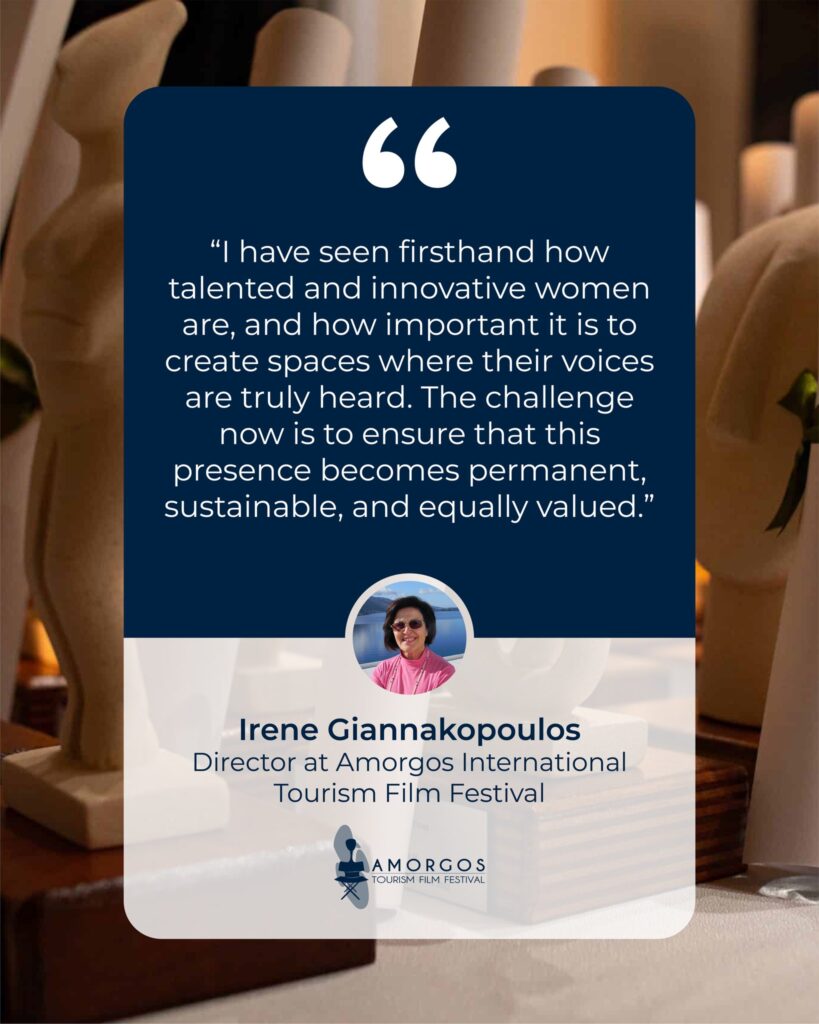
However, despite this progress, inequalities still exist, especially in access to funding, international distribution, and leadership positions. At the Amorgos Film Festival, I have seen firsthand how talented and innovative women are, and how important it is to create spaces where their voices are truly heard. The challenge now is to ensure that this presence becomes permanent, sustainable, and equally valued.
How can festivals and the wider audiovisual industry better support women’s voices and leadership?
Festivals and institutions have a responsibility to move beyond symbolic support and create real opportunities for women. This includes:
- Ensuring balanced representation in programming and in juries
- Supporting women-led projects through funding, mentorship, and visibility
- Creating safe and inclusive working environments
- Encouraging collaboration and international networking
Festivals are powerful platforms. When they consciously highlight women’s work and leadership, they send a strong message to the industry and to younger generations.
True support means building long-term structures that allow women to grow, lead, and innovate.
What advice would you give to women aiming for impactful work and international recognition?
I would encourage women to believe deeply in their own voice. Authenticity and personal perspective are powerful assets. They should tell the stories that truly matter to them. They should focus on continuous learning and networking. International festivals, workshops, and collaborations open important doors. Collaborations and relationships built on respect and shared values are very important.
They should believe in themselves. Persistence, professionalism, and consistency bring good results. There should be collaborations and support among other women. Women are strong and can succeed if they focus on their goals. Building strong, supportive networks creates healthier and broader opportunities for everyone.
How would you describe the presence of women in the industry today?
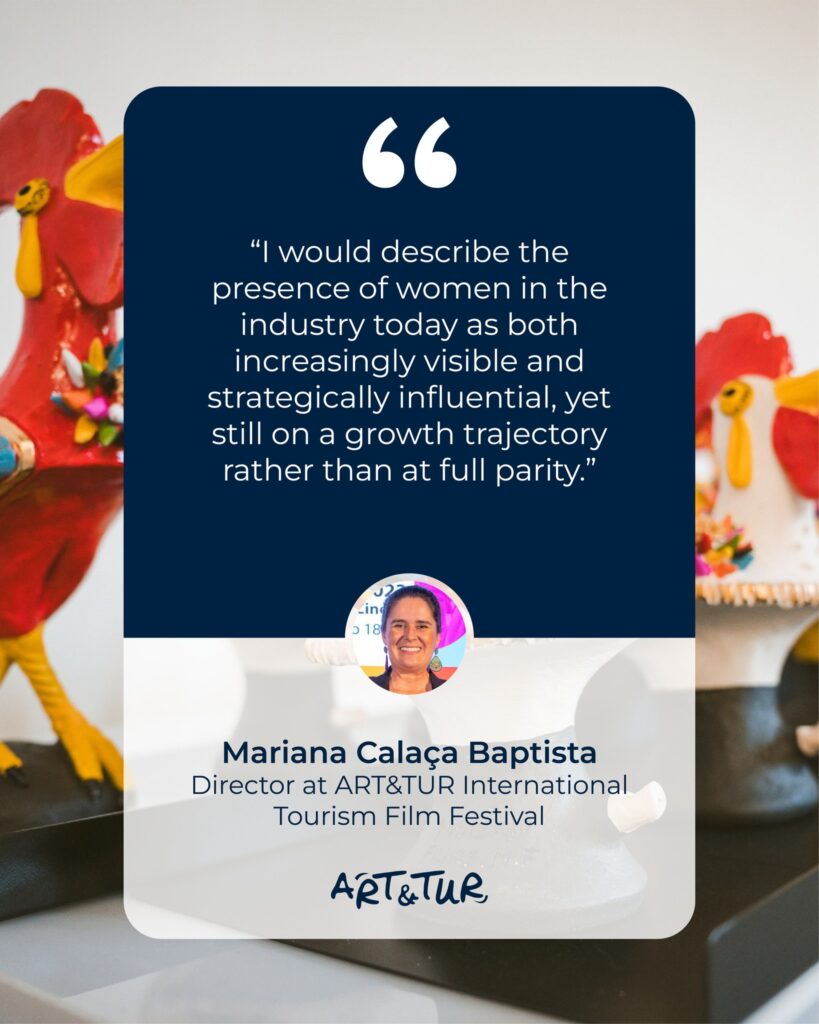
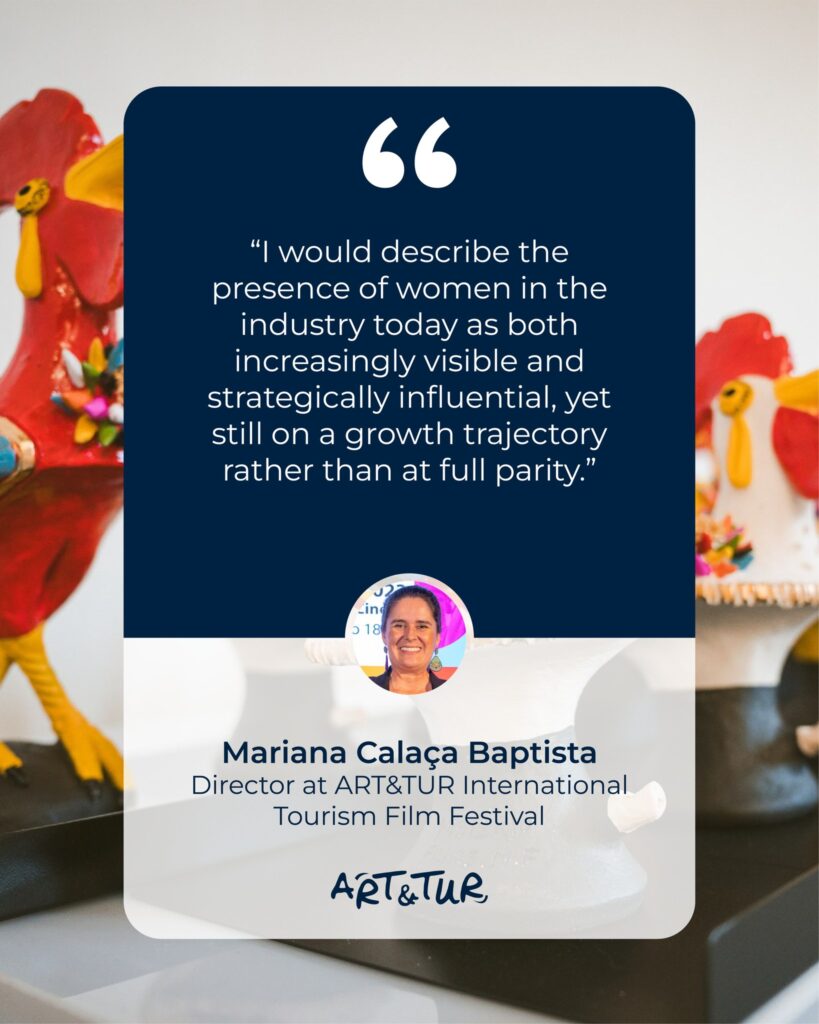
Based on my professional experience in festival management and audiovisual projects — particularly through my work with the Centro de Portugal Film Commission and ART&TUR – International Tourism Film Festival — I would describe the presence of women in the industry today as both increasingly visible and strategically influential, yet still on a growth trajectory rather than at full parity.
Over the years, my own multidisciplinary background — spanning architecture, cultural management, heritage, tourism, communication and creative consultancy — has given me insight into how women navigate and shape the cultural and audiovisual sectors. I’ve seen women take on leadership roles not only in creative direction and project coordination, but also in institutional frameworks that support film commissions, festivals, and regional audiovisual strategies.
In festival management and audiovisual production, women are now present as artistic directors, producers, programmers and strategists, bringing nuanced perspectives to storytelling and territorial branding. My role as Secretary of the Board at the Centro Portugal Film Commission and co-direction of key festival initiatives showcases how women can hold central leadership positions and directly influence how projects are structured, funded, and communicated.
At the same time, while women are increasingly visible, there remain structural challenges — particularly in technical and executive areas where men have traditionally dominated. Encouragingly, initiatives that promote diversity and mentorship are gaining traction, and women are carving out spaces where innovation, sustainable strategies, and entrepreneurial thinking thrive. This includes the expansion of roles into regional film ecosystems, international festival circuits, and cross-sectoral collaborations that link culture with tourism and economic development.
So overall, the landscape today is much more inclusive and dynamic than it was a decade ago. Women are not only present — they are shaping policy, defining narratives, and steering projects that have cultural, social and economic impact. The industry continues to shift toward greater equity, but there’s still work to be done to ensure that women have equal access to all spheres of influence and decision-making in audiovisual and festival environments.
How can festivals and the wider audiovisual industry better support women’s voices and leadership?
In my view, festivals and the wider audiovisual industry can better support women’s voices and leadership by moving from symbolic representation to structural commitment.
From my experience with the Centro de Portugal Film Commission and ART&TUR – International Tourism Film Festival, I’ve seen how festivals are not just exhibition platforms — they are ecosystems. They influence funding flows, industry recognition, networking opportunities, and long-term career trajectories. That means they carry real responsibility in shaping equity.
First, programming policies matter. Festivals can adopt clear diversity criteria in selection processes — not as quotas alone, but as curatorial commitments that ensure women directors, producers, and technical professionals are consistently present in competitive sections, juries, and industry panels. Visibility leads to credibility, and credibility leads to opportunity.
Second, leadership representation must extend beyond the screen. Women should be present in decision-making roles: artistic direction, executive boards, funding committees, and industry advisory groups. My own experience in governance roles has shown me how important it is for women to participate where strategic decisions are made — particularly regarding partnerships, financing structures, and regional audiovisual development.
Third, access to funding and markets needs to be strengthened. Dedicated pitching sessions, mentorship programs, and co-production forums that highlight women-led projects can create tangible pathways for sustainability. Festivals are uniquely positioned to connect creators with public institutions, tourism entities, cultural organizations, and international networks — expanding the impact of women’s work beyond a single screening.
Finally, long-term change depends on professional development and technical training. While creative roles have seen progress, technical and high-budget executive positions remain less balanced. Encouraging women’s participation in cinematography, sound design, production management, and strategic audiovisual policy is essential for deeper structural equity.
In short, festivals and the audiovisual sector can better support women not only by amplifying their stories, but by embedding equality into governance, funding, mentorship, and industry infrastructure. When women are supported at every level — creative, technical, and institutional — the entire ecosystem becomes more innovative, sustainable, and representative.
What advice would you give to women working in audiovisual who aim to create impactful work and gain international recognition?
I would say first and foremost: embrace the specificity of your voice. In today’s global audiovisual landscape, what travels internationally is not imitation — it is authenticity. The projects that resonate across borders are those rooted in a clear perspective, cultural identity, or strong conceptual framework.
From my experience in festival management and international positioning through initiatives such as ART&TUR and the work developed within regional film ecosystems, I’ve seen that impactful work often emerges where creative vision meets strategic thinking. Talent is essential — but so is understanding circulation: festivals, markets, co-production platforms, and institutional partnerships. International recognition rarely happens by chance; it is built through consistent presence, networking, and long-term positioning.
My advice would be:
1. Think beyond the project — think ecosystem.
2. Invest in professional networks.
3. Develop both creative and structural literacy.
4. Be resilient and consistent.
5. Support other women.
Leadership is not only individual. Building alliances with other women — sharing contacts, opportunities, and knowledge — creates collective momentum that benefits everyone. Ultimately, impactful and internationally recognized work comes from aligning purpose with strategy. When your creative identity is clear and your professional positioning is intentional, recognition becomes a consequence of coherence and sustained effort — not just visibility.
How would you describe the presence of women in the industry today?
Women have established a strong — and in some areas even dominant — presence in administrative, programming, and coordination roles across the festival and audiovisual sectors. Their contribution is essential to the industry’s success, quality, and growth.
However, despite clear progress, women remain underrepresented in technical roles, senior leadership positions, and high-budget productions. Gender inequality is still visible, especially in decision-making roles and career advancement opportunities. In many contexts, the gender pay gap also persists, with women still earning less than men for the same work and qualifications.
Overall, the industry has moved forward, but not yet far enough. The next phase must focus on structural change, not only visibility.
How can festivals and the wider audiovisual industry better support women’s voices and leadership?
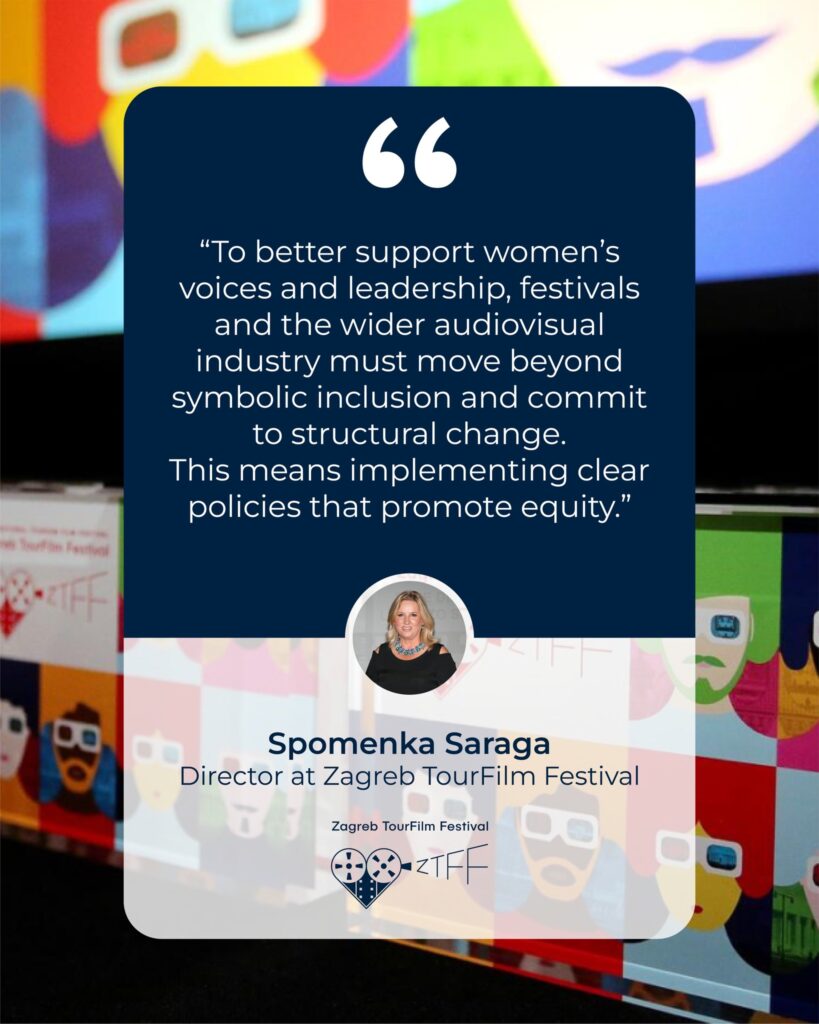
To better support women’s voices and leadership, festivals and the wider audiovisual industry must move beyond symbolic inclusion and commit to structural change.
This means implementing clear policies that promote equity — such as gender-balanced selection committees, parity in decision-making bodies, targeted mentorship programs, and improved access to financing for female-led projects. Festivals can also play a key role by committing to more balanced programming and by creating spaces where women’s work is not only included, but meaningfully supported and promoted.
Research consistently shows that the gender gap remains significant across many professional roles in audiovisual production. While women are more present in areas such as wardrobe, make-up, and hairdressing, they remain notably underrepresented in directing, cinematography, sound, and music composition. Vertical segregation is also still present, which limits women’s access to leadership and decision-making positions.
According to findings from the European Audiovisual Observatory (2018–2022), women remain underrepresented across the European feature film workforce, with only a minority of directors, cinematographers, and composers being female. Progress is visible, but slow, and uneven across countries and professions. These findings underline the need for long-term policies, data-driven monitoring, and sustained institutional commitment.
Key insights for the period 2018 – 2022:
- Women are still largely underrepresented in the workforce. Only 26% of directors of European feature films are female.
- Among behind-the-camera roles, the highest female presence was registered among producers (35%) and screenwriters (29%).
- The gender gap was most pronounced among cinematographers and composers, with women representing 11% and 10% of active professionals, respectively.
- The share of female professionals is progressing slowly, with variations across Europe.
- On average, female professionals in film crews worked on slightly fewer films than their male counterparts, except for film editors.
- Women in key crew positions were more likely than their male colleagues to work in teams and in gender-mixed settings.
- Documentary was the film genre with the highest share of female professionals, considering all crew roles.
- Data suggest a positive correlation between the presence of at least one female co-director and an increase in the share of women working in film crews.
(European Audiovisual Observatory)
What advice would you give to women working in audiovisual who aim to create impactful work and gain international recognition?
First and foremost: work hard, stay resilient, and believe in your voice. Creating impactful work — and achieving international recognition — requires more than talent alone. It takes sustained effort, discipline, and the ability to keep going through setbacks, uncertainty, and long development cycles. It also means pushing beyond your comfort zone and staying committed to high standards.
At the same time, artistic vision should be combined with strategic thinking: understand the business side of the industry, build strong networks, seek mentors and collaborators, and advocate for your work with confidence. A proactive, unapologetic approach to career development is often just as important as the work itself. And yes — a bit of luck always helps. But preparation, consistency, and courage make luck much more likely to find you.
How would you describe the presence of women in the industry today?
Throughout my professional journey, I have met wonderful women who have inspired me in many ways. In the context of festivals—particularly within the tourism audiovisual sector—I feel there is a fair level of representation. However, senior leadership roles are still predominantly occupied by men. When it comes to audiovisual productions more broadly, I notice a significantly higher presence of male professionals. Documentaries tend to be a common format for women filmmakers, but in the field of commercial productions, I have rarely encountered female directors during my years of experience.
How can festivals and the wider audiovisual industry better support women’s voices and leadership?
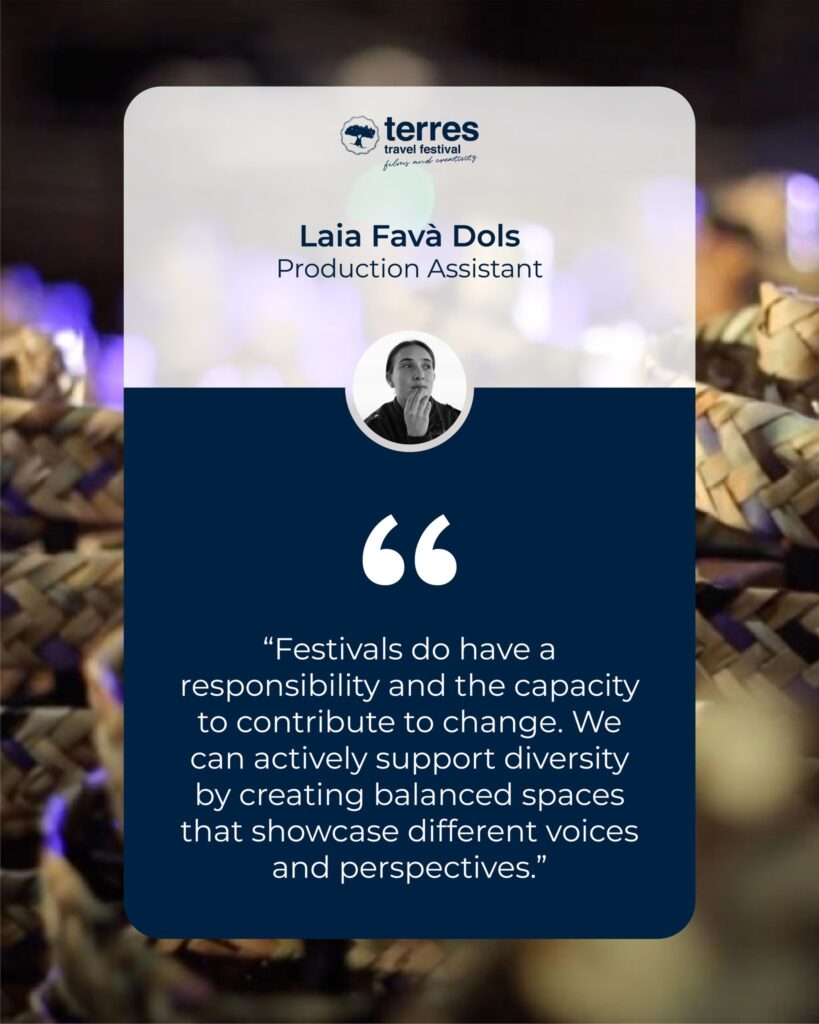
I don’t believe the root of the problem lies within festivals themselves. Festivals are, to a large extent, a reflection of the industry. By the time projects reach us, many structural decisions have already been made earlier in the production and financing stages. That said, festivals do have a responsibility and the capacity to contribute to change. We can actively support diversity by creating balanced spaces that showcase different voices and perspectives, rather than reinforcing a single dominant viewpoint. However, meaningful and lasting change needs to happen earlier in the value chain, before projects even reach festivals.
What advice would you give to women working in audiovisual who aim to create impactful work and gain international recognition?
I would encourage them to remain deeply connected to their own voice and perspective, as this authenticity often resonates on a global scale. At the same time, understanding the workings of the industry is crucial. I would advise them to cultivate strong networks, identify the right platforms and partners, and strategically position their projects from an early stage to maximize impact.
How would you describe the presence of women in the industry today?
First of all, I would like to say that the audiovisual industry is a wonderful field to be part of. It is an industry filled with creativity, productivity, innovation, and inspiring people. When it comes to women’s representation, unfortunately — as in many other sectors — it remains largely male-dominated. However, the women who are active in the industry today are exceptionally powerful, motivated, intelligent, ambitious, and creative. A woman’s touch can truly be seen and felt in audiovisual projects. It often brings emotional depth, sensitivity, strength, and a distinct creative perspective that enriches storytelling and production as a whole.
How can festivals and the wider audiovisual industry better support women’s voices and leadership?
- Creating grants and funding opportunities specifically dedicated to women creators.
- Actively selecting women leaders as keynote speakers, panelists, and mentors.
- Offering workshops and leadership programs led by inspiring women professionals.
- Promoting visibility and recognition of women’s achievements.
- Encouraging long-term development, allowing women the time and space to evolve creatively and professionally.
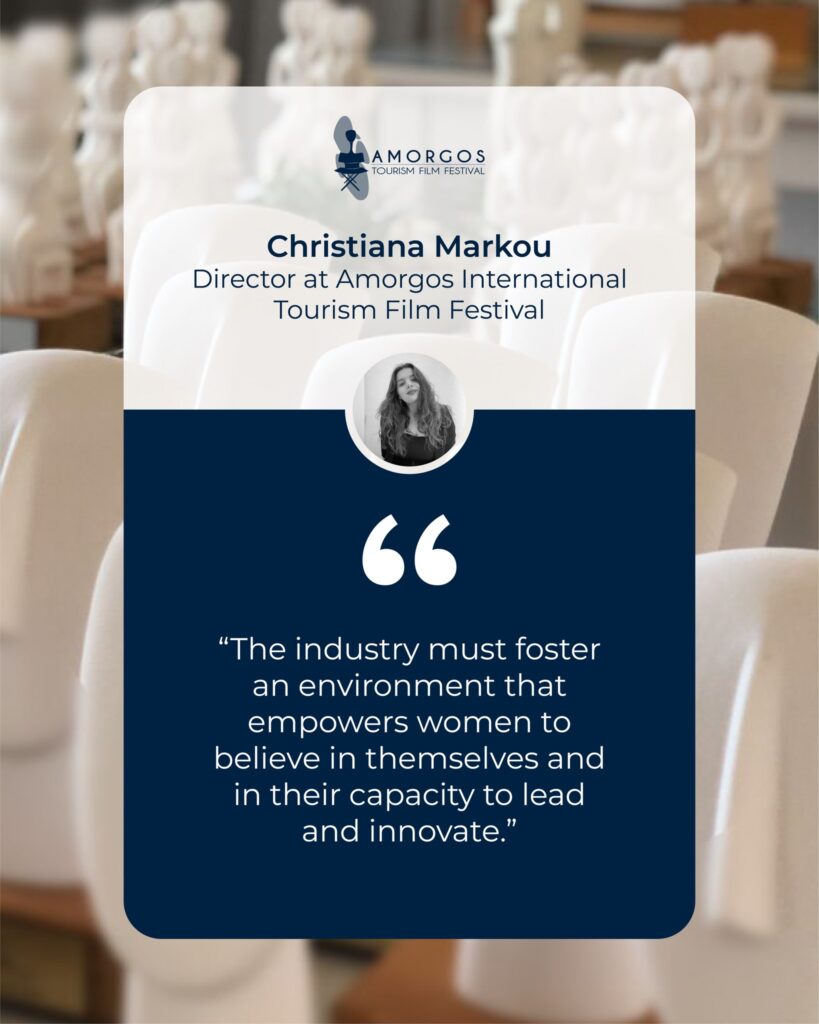
Most importantly, the industry must foster an environment that empowers women to believe in themselves and in their capacity to lead and innovate.
What advice would you give to women working in audiovisual who aim to create impactful work and gain international recognition?
Keep working. Keep evolving. Keep learning. Never allow yourself to feel underestimated or less powerful because you are a woman. Being a woman is not a limitation; it is a strength. It is a source of perspective, resilience, and creativity. Believe in your voice. Trust your vision. And understand that your authenticity is your power. International recognition comes from consistency, growth, and the courage to stay true to your creative identity. Keep evolving. Keep creating. Your voice belongs on every screen.
Looking Forward
The insights of Irene Giannakopoulos, Mariana Calaça Baptista, Spomenka Saraga, Laia Favà Dols, and Christiana Markou make one thing clear: women are shaping the future of festivals and the audiovisual industry, but progress requires more than visibility—it demands intentional action. From equitable programming and leadership opportunities to mentorship, networking, and structural support, change depends on both systemic commitment and individual persistence.
As these festival leaders show, amplifying women’s voices isn’t just about fairness—it strengthens creativity, diversity, and innovation across the industry. The challenge now is to turn awareness into concrete, lasting structures that allow women to lead, create, and inspire on every stage.
CIFFT – WORLD-WIDE RECOGNITION FOR YOUR FILMS

M.Z.I. Dalton Zahir | from TT Desk