World Environment Day 2026: A Global Call for Climate Action
As the planet swelters, World Environment Day 2026 focuses on urgent climate action
Messages
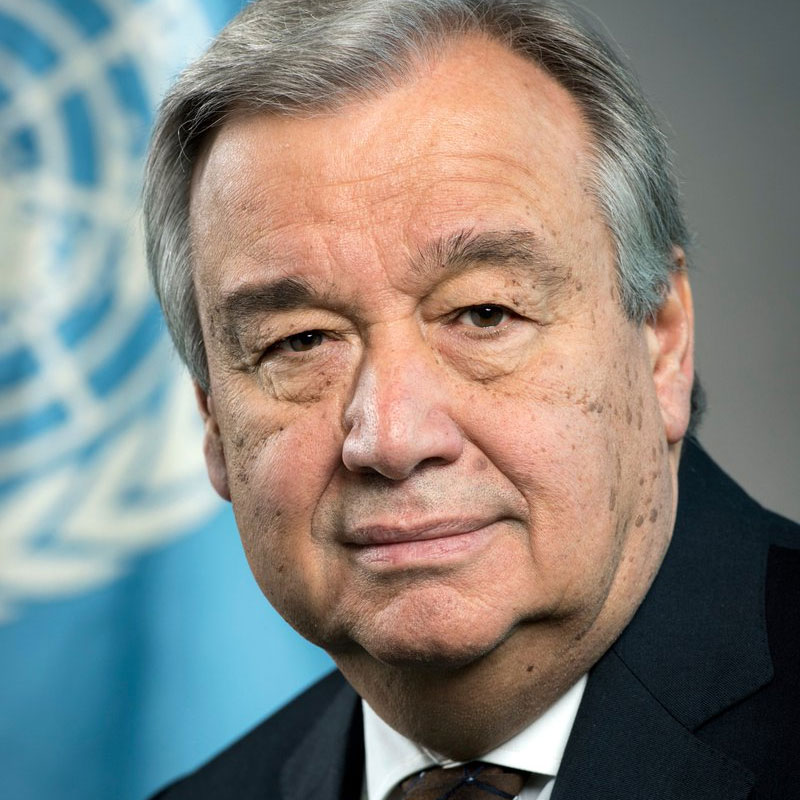
2026 Secretary-General’s Message
This World Environment Day, warning signals are everywhere.
The past eleven years have been the eleven hottest on record.
And the damage goes far beyond rising temperatures – from polluted air to degraded land, collapsing ecosystems, and vanishing biodiversity.
Harming health, destroying homes and deepening hunger.
The world is heading for a temporary overshoot above 1.5 degrees.
Every fraction of a degree brings greater harm – especially to the most vulnerable.
Our task is to make that overshoot as small, as short, and as safe as possible – and rapidly bring temperatures back down.
That means slashing emissions.
Accelerating a just transition away from fossil fuels and towards renewables – the only sustainable path to lower costs and to real energy security.
Cutting methane – one of the fastest, cheapest ways to limit near-term warming.
Protecting forests, land, and seas.
Helping communities adapt to the devastating impacts already here.
And it means fulfilling climate finance promises to developing countries – to save lives, protect livelihoods, and strengthen economies.
This is the moment to act – for our environment and for our future
António Guterres
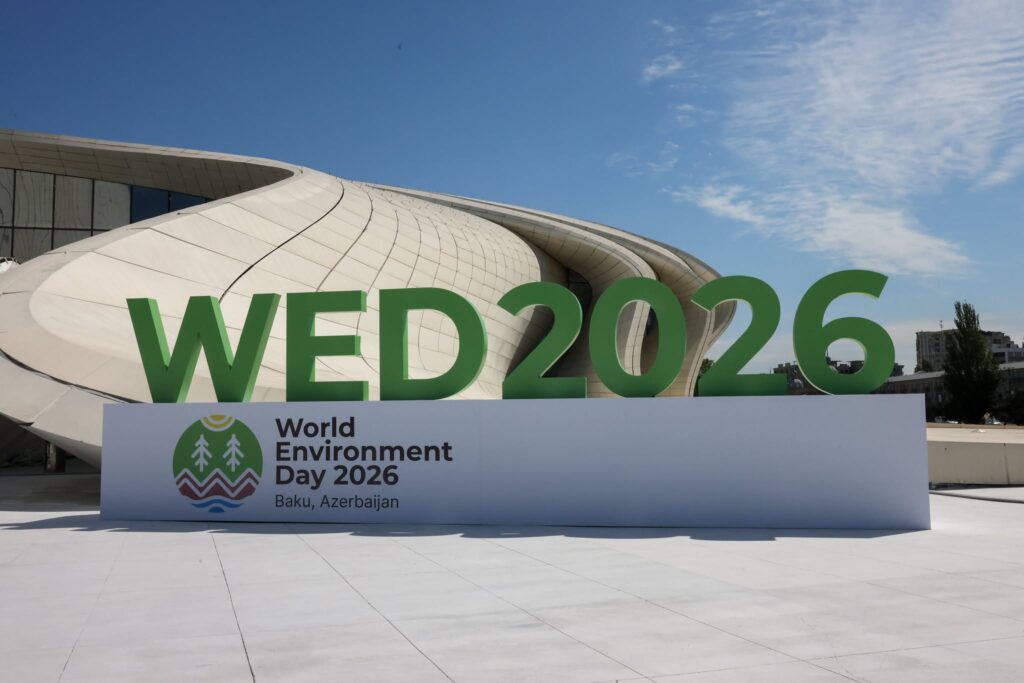
Baku, 5 June 2026 – With global temperatures at near-record levels and El Niño set to return, governments, businesses, communities, and individuals across the world today marked World Environment Day, sounding the alarm on the need to urgently address climate change. This year, Azerbaijan hosted the official commemoration of World Environment Day.
Extreme heat is one of the deadliest and fastest-growing climate threats to lives, livelihoods, and economies. With overshoot of the Paris Agreement goal of 1.5°C now almost inevitable and impacts escalating, the world must act #NowforClimate, cutting emissions and adapting to rising risks.
“This World Environment Day, warning signals are everywhere. The past eleven years have been the eleven hottest on record… The world is heading for a temporary overshoot above 1.5 degrees,” UN Secretary-General António Guterres said in his message for World Environment Day 2026. “Our task is to make that overshoot as small, as short, and as safe as possible – and rapidly bring temperatures back down.”
“That means slashing emissions. Accelerating a just transition away from fossil fuels and towards renewables – the only sustainable path to lower costs and to real energy security. Cutting methane – one of the fastest, cheapest ways to limit near-term warming. Protecting forests, land, and seas. Helping communities adapt to the devastating impacts already here. And it means fulfilling climate finance promises to developing countries – to save lives, protect livelihoods, and strengthen economies,” he added. “This is the moment to act – for our environment and for our future.”
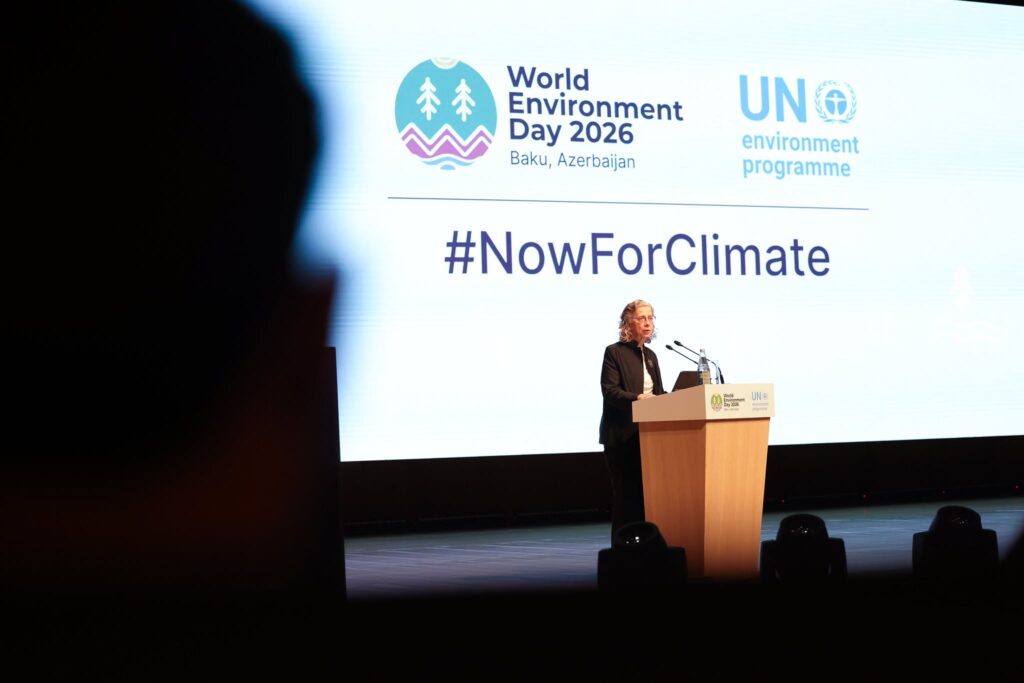
At the official ceremony for World Environment Day in Baku, Azerbaijan, officials highlighted the need for urgent collective and individual action to stave off the worst impacts of climate change and adapt to a changing environment.
“As our planet continues to face down the devastating impacts of climate change, Azerbaijan is honoured to host World Environment Day 2026 and join calls to address this global crisis. The science is clear: every fraction of a degree of warming costs lives, livelihoods, and ecosystems — and no country is spared,” said Rashad Ismayilov, Azerbaijan’s Minister of Ecology and Natural Resources. “This year’s focus on climate action could not be more timely. Azerbaijan is committed to nearly doubling its renewable energy capacity by 2030 and implementing a 1.5°C-aligned climate action plan alongside our partners. We call on governments, industries, and citizens worldwide to match ambition with urgent action.”
Azerbaijan, like countries across the world, is working to address climate impacts, including the shrinking of the Caspian Sea, the world’s largest inland body of water. Alongside conservation efforts, the Government has pledged a 40 percent emissions reduction by 2035, and has a renewable energy target of 30 percent by 2030. Azerbaijan has also shown global leadership in multilateral environmental processes, including hosting the UN Climate Change Conference (COP29) and, more recently, the World Urban Forum.
Speaking at the official celebration, Inger Andersen, UNEP’s Executive Director, said: “World Environment Day is not just sending a message; it is passing one on. The planet has, for years, been sending signals that its limits are approaching.”
“We can prevail in this fight for the planet’s future. We can craft our own story by acting to slow and adapt to climate change – delivering safer, healthier, more prosperous, and more equitable societies for all. But it will take all of us: from the wealthiest nations and individuals, who hold the biggest responsibility for the climate crisis and so can make the biggest difference, to grassroots climate activists and ordinary people,” she added.
Governments, businesses, educational institutions, civil society, and communities across the world joined in efforts to advocate for action to address climate change for the good of people and planet. More than 2,000 World Environment Day events were registered worldwide this year.
A high-level commemoration was held at the UN Secretariat in New York to highlight the importance of collective and transformative action to tackle climate change. In Santiago, Chile, an in-person editathon organized by UNEP and the Food and Agriculture Organization of the UN, together with the Wikimedia Chile organization, focused on strengthening environmental content and tackling misinformation on Wikipedia, especially for Spanish language wikis. A similar editathon in Nairobi, Kenya, produced tangible results: 15 new articles created, 121 articles edited, 336 total edits, 511 references added, 23 uploads to Wikimedia Commons, and 69,500 words added to the encyclopedia.
Ahead of World Environment Day, more than 50 cities across the world joined UNEP’s new 50@50 activation to confront one of the world’s fastest-growing and deadliest climate risks: extreme heat. Cities across the world, including Antalya, Lagos, Melbourne, Mendoza, Paris, and Yangzhou, have come together through the activation to learn from each other’s experiences, share tested approaches to extreme heat adaptation and preparedness as well as sustainable cooling solutions.
The growing movement was reflected in related activities worldwide, from climate resilient building initiatives at Brazil’s Museum of Tomorrow and public exhibitions to a chess-inspired campaign in India featuring five-time World Chess Champion Viswanathan Anand, highlighting how extreme heat can affect concentration, performance and daily life and urging faster action on sustainable cooling solutions.
On 3 June, UNEP launched a new policy brief, Cheaper. Cleaner. Unstoppable. Clean technologies that are delivering for the climate, which highlights a powerful and hopeful shift: many clean solutions are no longer niche—they are becoming the new normal. Across energy, transport, buildings, and food systems, ‘positive tipping points’ are emerging. As costs fall, technologies scale, and public support grows, adoption is accelerating in self-reinforcing ways. Solar power, electric mobility, and sustainable cooling are proving that climate action can be economically competitive, socially beneficial, and globally scalable. The policy brief shows that the transition is not only possible — it is already underway.
In the runup to World Environment Day, UNEP also launched the world’s first global Climate Dance Challenge, inviting people everywhere to take part in the “Climate Limbo” as a creative signal to world leaders. Thousands of participants have already learned the moves, filming and posting their own versions on TikTok, Instagram, or YouTube, tagging #NowForClimate and @UNEP, and challenging friends to join in. The dance is set to the global dance anthem “Deep Down” by Grammy-nominated Brazilian DJ, Alok, who was recently designated as a UNEP Goodwill Ambassador. Several UNEP Goodwill Ambassadors and Advocates supported the campaign, including Jason Momoa, Amber Valetta, Antoinette Taus, Karry Wang, Dia Mirza, and Frida Amani. A flash mob in New York City also joined the fun, orchestrating the limbo on Broadway, while in Bangkok, UNEP and partners brought the Climate Dance Challenge to Lumphini Park.
Over the past week, the Altyn Dala Conservation Initiative has released eight of the world’s last truly wild horses into Kazakhstan’s steppe for World Environment Day. The horses, which have been absent for over 200 years, now help reduce wildfire risk and improve soil carbon storage.
Celebrations in Baku featured a special acoustic performance by Korean-Canadian artist Mark Lee. Known for his work with NCT and SuperM, Lee is one of the most recognizable and influential figures in contemporary K-pop, celebrated for his versatility as a rapper, performer, and songwriter. The unreleased song he performed was inspired by Kenya’s Maasai Mara National Reserve, following a visit to the country and UNEP headquarters earlier this year.
Billboards and public screens around the world – including in Algeria, Argentina, Brazil, China, Jordan, Kenya, Mexico, Morocco, Paraguay, the UK, the US, and Uruguay – showcased public messages about climate change, while iconic buildings in Brussels, Geneva, and Osaka lit up in green in honour of World Environment Day.
World Environment Day 2027 will be hosted by Serbia.
NOTES TO EDITORS
Find all World Environment Day communication materials here: social media cards, feature stories, videos, design templates, key messages, brand guide, and logos.
About World Environment Day World Environment Day on 5 June is one of the biggest international days for environmental advocacy. Led by UNEP and marked annually since 1973, the event has grown to be the largest global platform for environmental outreach, with millions of people from across the world engaging to protect the planet.
About the UN Environment Programme (UNEP) UNEP is the leading global voice on the environment. It provides leadership and encourages partnership in caring for the environment by inspiring, informing and enabling nations and peoples to improve their quality of life without compromising that of future generations.
-The planet doesn’t argue. It doesn’t negotiate. It sends signals—rising seas, raging wildfires, heatwaves, melting glaciers.
We said 1.5°C was the limit. We are crossing it.
For decades, the world has heard the climate story—warnings, targets, distant deadlines. Too often, the response has been clouded by noise: delay, distraction, denial.
But listen closer now. Beneath the noise, another signal is rising. Solar panels stretch across rooftops. Wind turbines line the horizon. Cities are being redesigned for people. Forests are being replanted. Climate solutions are taking root in every corner of the planet.
World Environment Day 2026: A Global Call for Climate Action
The planet doesn’t argue. It doesn’t negotiate. It sends signals—rising seas, raging wildfires, heatwaves, melting glaciers.
We said 1.5°C was the limit. We are crossing it.
For decades, the world has heard the climate story—warnings, targets, distant deadlines. Too often, the response has been clouded by noise: delay, distraction, denial.
But listen closer now. Beneath the noise, another signal is rising. Solar panels stretch across rooftops. Wind turbines line the horizon. Cities are being redesigned for people. Forests are being replanted. Climate solutions are taking root in every corner of the planet.
#WorldEnvironmentDay 2026 focuses on climate change—on the urgent signals the Earth is sending and the signals we choose to send back. UNEP’s global campaign calls on all of us to step in #NowForClimate, and steer a world already in motion. See how you can get involved.
Azerbaijan will host the global observance, while a cascade of events, campaigns, and creative actions will unfold across continents—on screens, in streets, and in communities everywhere.
Mark 5 June 2026 for one of the world’s largest international days for the environment. Stay tuned for updates, resources and opportunities to join this global moment for action and hope.
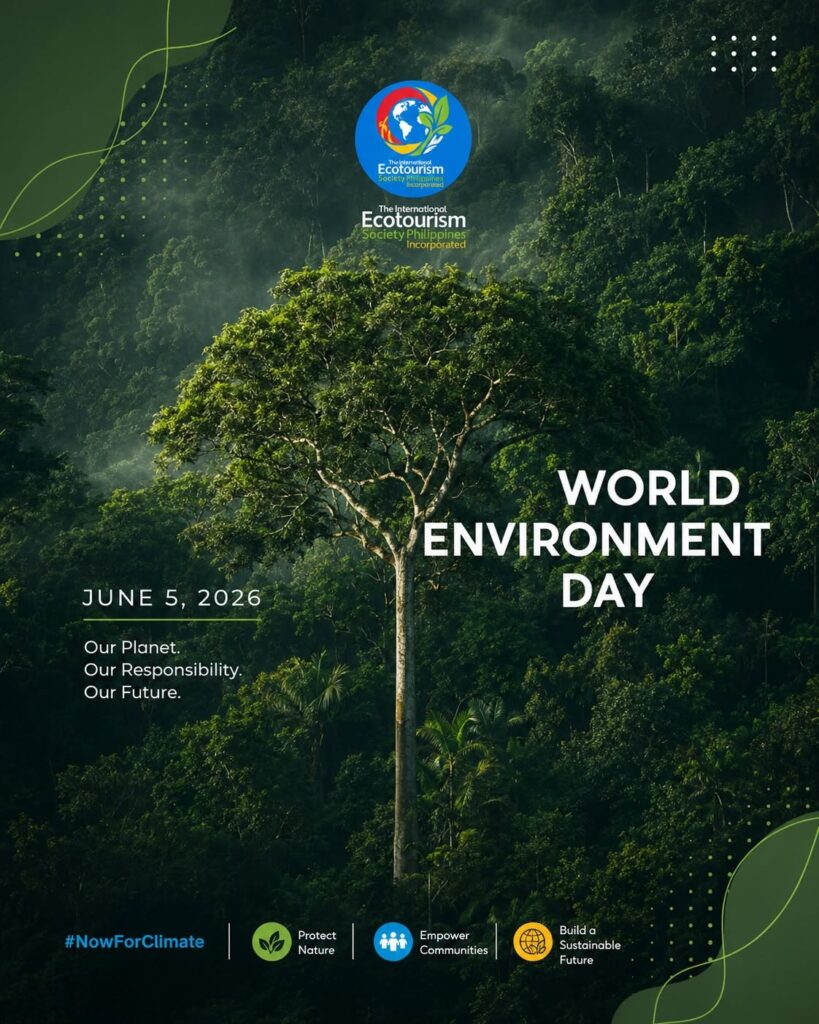
WORLD ENVIRONMENT DAY 2026
The future of our planet depends on the choices we make today.
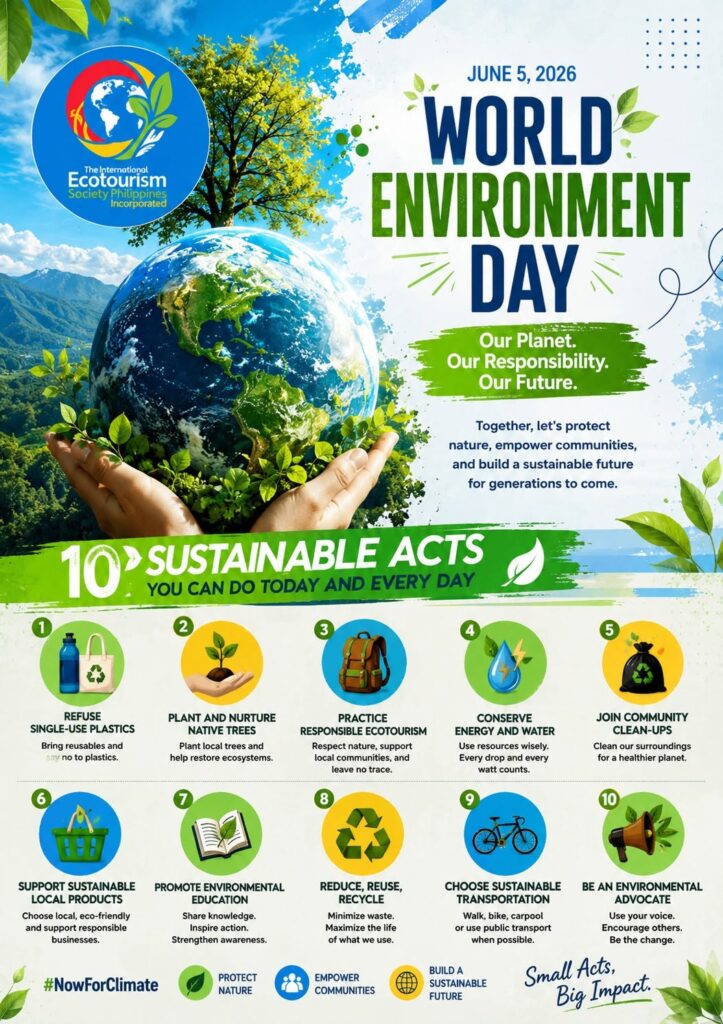
This World Environment Day, The International Ecotourism Society Philippines Incorporated (TIESPHI) invites everyone to embrace sustainable actions that protect our environment, conserve biodiversity, and strengthen communities.
From refusing single-use plastics and planting native trees to supporting sustainable local products and practicing responsible ecotourism, every action—no matter how small—creates a positive impact for future generations.
Together, we can transform awareness into action and action into lasting change.
Protect Nature
Empower Communities
Build a Sustainable Future
Remember: sustainability is not a one-day commitment—it is a way of life.
Join the TIESPHI Sustainable Act Challenge and commit to at least one eco-friendly action today and every day.
World Environment Day 2026 unites millions around the world in a call for climate action
Florian Fussstetter/UNEP
In most countries, World Environment Day has drawn to a close. And what a celebration it has been.
Thousands of events were held around the world while millions of people participated online, shining a spotlight on solutions to the climate crisis.
UN Secretary-General António Guterres used the day to call on countries to transition away from fossil fuels while protecting natural spaces and helping communities already struggling with climatic upheaval. “This is the moment to act – for our environment and for our future,” he said in a video message.
In Azerbaijan, this year’s World Environment Day host, Minister of Ecology and Natural Resources Rashad Ismayilov urged countries to act quickly to stem greenhouse gas emissions and keep alive the Paris Agreement goal of limiting global warming to 1.5°C. “The science is clear: every fraction of a degree of warming costs lives, livelihoods, and ecosystems – and no country is spared,” he said.
Above all, World Environment Day is about mobilizing the public to take action for the planet. And boy did the public respond. More than 2,200 events were held around the world, from a Wikipedia edit-athon in Nairobi to a dance mob in New York.
Many took part in UNEP’s Global Limbo Challenge, which called on people around the world to do the classic dance move to Deep Down by Brazilian musician Alok, UNEP’s newest Goodwill Ambassador. The campaign – meant to raise awareness about the need to lower global temperatures – went viral, with everyone from soccer stars to soccer moms showing just how low they can go.
All of this helped spread the word about World Environment Day far and wide. By the halfway mark of 5 June, content related to the celebration had reached 57 million people online, with more than 1 million engagements. Just over 20,000 articles were published about World Environment Day across 139 countries.
For many, the day drew attention to the climate crisis at a pivotal time.
“The planet is sending us signals – heatwaves, droughts, floods – harming us all, especially the most vulnerable,” said UNEP Executive Director Inger Andersen. “We must act on climate change as though our lives depend on it. Because they do.”