AIRPORT 2.0:THE FUTURE IS BOARDING NOW
Interview : AIRPORT 2.0: THE FUTURE IS BOARDING NOW
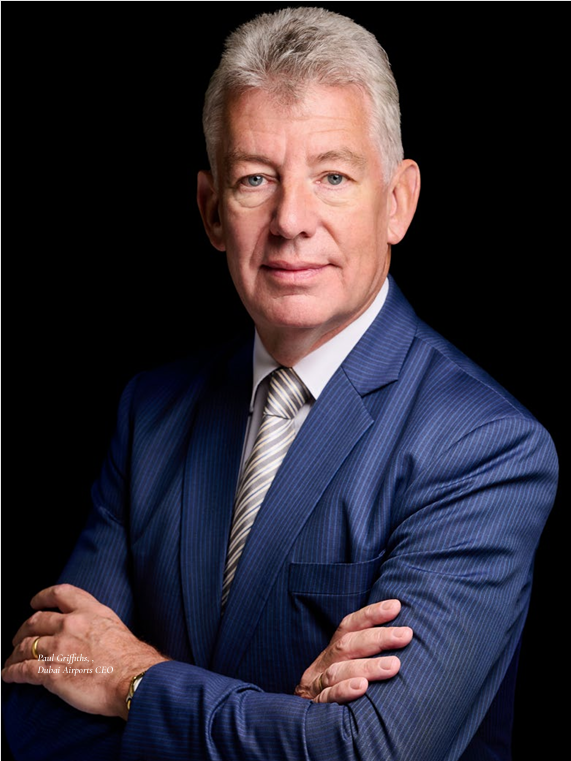
Interview with Paul Griffiths, Dubai Airports CEO
Dubai Airports has been a global pioneer in adopting biometric
technology and AI-powered systems. Could you share how
innovations like Smart Gates and the integrated Airport Operations
Control Centre are shaping a more seamless, secure, and intelligent
passenger experience at DXB?
At Dubai Airports, technology is not only a means of
enhancement, it’s the backbone of our vision for future
travel. We were among the first airports globally to introduce
biometric-enabled Smart Gates in the early 2000s. These
Gates offer swift, contactless immigration clearance. Dubai
Airports also collaborated with Emirates for an end-to-end
biometric pathway at Dubai International (DXB) Terminal 3,
enabling guests to check in, access lounges, clear immigration,
and board using facial recognition alone. This is part of a
wider ambition to create a truly seamless guest journey.
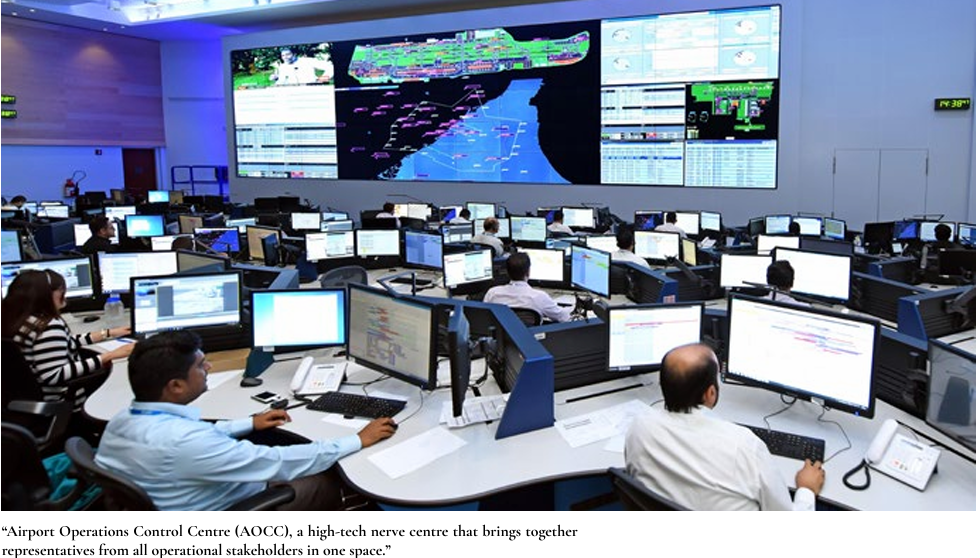
A key enabler of this transformation is our Airport Operations
Control Centre (AOCC), a high-tech nerve centre that brings
together representatives from all operational stakeholders in
one space. By using real-time heat maps, predictive analytics
and AI flow modelling, the AOCC helps us manage guest
movement, allocate resources, and reduce queue times. The
result is a more agile, coordinated response to demand surges.
We’ve also adopted advanced security screening machines
that allow laptops and liquids to remain in hand baggage,
doubling throughput and reducing guest inconvenience.
These solutions allow us to boost capacity without expanding
our physical infrastructure, which is critical in a landlocked
airport like DXB. Ultimately, our digital transformation is
about marrying operational efficiency with guest satisfaction.
We reduce friction, eliminate queues, and create dwell time
that can be enjoyed rather than endured. We adapt the
technology in a way that increases flow rates at DXB and
keeps everyone happy. More people are coming every year—
93.6 million in 2024, and we’re looking like we could top
100 million annual guests by 2027, which would be another
massive milestone for us.
How is Dubai Airports leveraging digital twin technologies,
productive data platforms and machine learning to manage growth
while maintaining world-class service standards?
Our in-development Disruption Digital Twin will give us a
live, integrated view of our operations, enabling dynamic re
planning of flights, staffing, and resources in real time. This
is part of a wider shift towards data- led, predictive airport
management. Machine learning forecasts guest flows for
accurate manpower planning, while AI cameras on aircraft
stands improve departure predictions and gate readiness. But
data alone is not enough. It must be paired with purpose. That’s
why we see ourselves first and foremost in the hospitality
business. Technology supports our people in delivering service
excellence by streamlining processes, improving information
flow, and empowering better decision-making. We measure
our success not by throughput alone, but by how our guests
feel as they move through our airport.
As a major hub for global travel and tourism, what investment
priorities are you setting to strengthen Dubai Airports’
infrastructure and digital ecosystem, especially as the world moves
into a more AI- driven, hyperconnected era?
Our investments focus on increasing capacity and elevating
the guest experience without building unnecessarily. This
includes biometric touchpoints, smart baggage systems,
predictive modelling tools and AI- assisted operations.
“
With DWC, we have the rare opportunity to build a
future-facing airport from the ground up. Considering
the speed with which air travel and technology are
evolving, the ten-year timeline for the project means
that we are probably talking about innovations,
concepts and ideas that have either not been conceived
yet or are in their nascent stage.
“
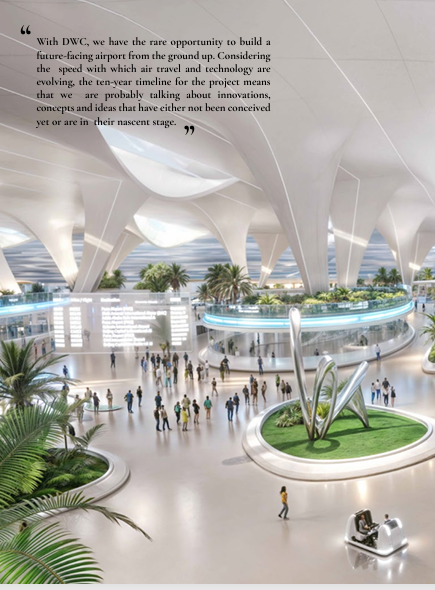
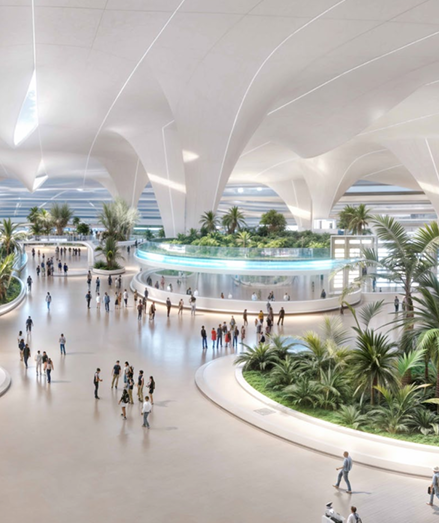
The development of Dubai World Central – Al Maktoum
International (DWC) will be a multimodal, biometrically
enabled hub with seamless links to road, rail and aerial
mobility solutions. Our ambition is to deliver an airport
that reflects future travel trends. That means designing for
personalisation, sustainability and interoperability.
Sustainability is becoming an integral part of aviation’s future.
How is Dubai Airports integrating green technologies and energy
efficient infrastructure into its growth strategy? Could you also
share more about your goals around reducing environmental
impact?
Sustainability is a design principle across every facet of our
operations. Progress has been driven by strong collaboration
with our partners, enabling key initiatives such as the
installation of over 62,000 solar panels to offset 23,000 tonnes
of CO₂ annually, the transition of all non-electric airside
vehicles to biodiesel, and a waste management programme
that has significantly reduced landfill waste. These are part
of a coordinated, airport wide approach to decarbonisation
delivered through collective action across the ecosystem.
In recognition of this commitment, DXB was awarded
Level 4 ‘Transformation’ under the ACI Airport Carbon
Accreditation programme.
Beyond sustainability, your organisation is also known for its
community-focused and socially responsible programs. How does
Dubai Airports approach corporate responsibility — particularly in
areas such as workforce development, accessibility, and partnerships
with local communities?
We are proud to be one of the UAE’s largest employers, and
our employees are the heartbeat of our success. Earlier this
year, we received the Gallup Exceptional Workplace Award.
A testament to our sustained focus on employee wellbeing,
engagement and career development. We’ve also embedded
accessibility into our guest journey. DXB is the world’s first
international airport to earn the Certified Autism Centre™
(CAC) designation, awarded by the International Board
of Credentialing and Continuing Education Standards
(IBCCES). With dedicated quiet rooms, employee training,
and awareness campaigns like “We All Meet the World
Differently”, we’re continually improving services for guests
with visible and hidden disabilities.
You’ve led Dubai Airports through incredible expansion and
transformation over the years. What has personally driven your
long-standing dedication to the aviation industry, and what
leadership values continue to guide your journey at the helm of
one of the world’s most dynamic airport networks?
Aviation is a great connector, bringing people, ideas and
cultures together. When I joined Dubai Airports, we had a
bold ambition: to turn a regional hub into the world’s leading
aviation getaway. That required not only infrastructure and
investment, but a collective mindset committed to excellence.
We made decisions to innovate, to take risks, and to unite
behind a shared vision. We work in a sector that is constantly
evolving— success lies in embracing that change and in being
proactive about shaping the future rather than reacting to it.
I believe in trusting teams, empowering people, and making
decisions with clarity and conviction. Most of all, I believe in
putting the guest at the centre of everything we do.
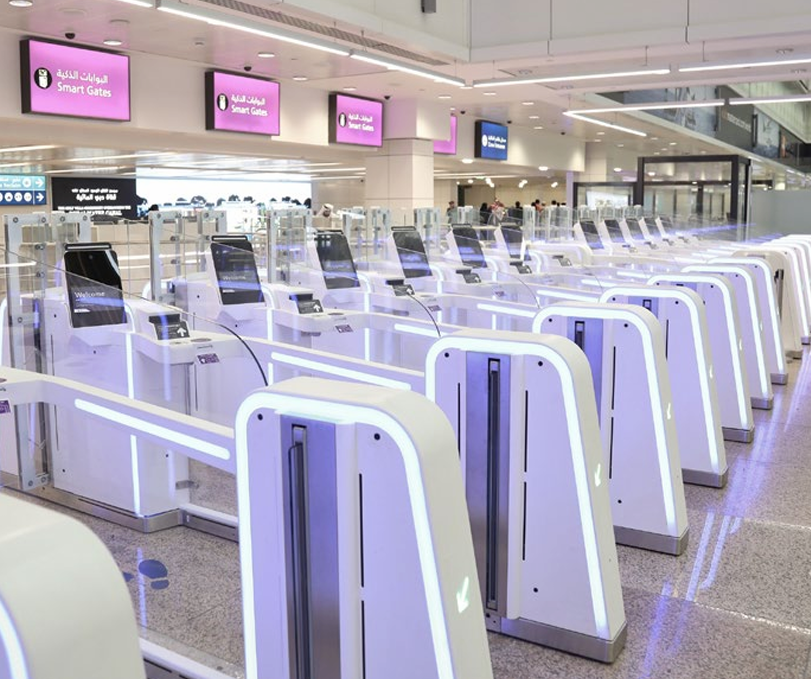
“We were among the first airports globally to introduce biometric-enabled Smart Gates in the
early 2000s. These Gates offer swift, contactless immigration clearance.
Looking ahead, where do you see the most exciting intersections of
AI, tourism, and infrastructure investment — and what role will
Dubai Airports play in shaping the global travel experience of the
future?
AI, tourism and infrastructure are no longer separate
conversations, they are converging to redefine how the world
moves. Airports are becoming more than transit spaces.
They’re becoming interconnected networks, designed to
deliver experiences, not just process passengers. Our focus
is on building intelligent systems that anticipate demand,
remove friction and enable personalisation. That includes
everything from automated baggage handling to predictive
maintenance and biometric corridors.
With DWC, we have the rare opportunity to build a future
facing airport from the ground up. Considering the speed
with which air travel and technology are evolving, the ten
year timeline for the project means that we are probably
talking about innovations, concepts and ideas that have either
not been conceived yet or are in their nascent stage. Airports
have a habit of legacy processes, but we are determined to set
an example and engineer this out. This decision will have a
significant bearing on Dubai’s position as the world’s hub of
choice and its reputation as a leader in the aviation sector,
and we will have to be very diligent to get it right, but we aim
to retain our edge over the competition for the foreseeable
future.
We’re integrating smart mobility, AI, and real-time data flows
to create a dynamic, scalable environment. I’m particularly
excited about advanced aerial mobility, including the
potential for pilotless air taxis to become part of the airport
travel journey. As travel becomes more hyperconnected,
seamless, and sustainable, we remain committed to shaping
that future, ensuring every journey through Dubai is not only
efficient, but memorable.
Curtesy by world magazine